The Scottish Centre for Excellence in Dentistry was created to offer something that is still rare in private dental care: a single home where consultants, specialists and experienced dentists work side by side for the good of each patient. Since opening its doors in 2009, the practice has grown into one of the largest private dental centres in Europe. Within a year, it was recognised as the best specialist referral practice in the United Kingdom, and it has kept building on that reputation ever since. Today, the centre welcomes patients who refer themselves as well as patients sent by around fifteen hundred dentists who trust the team with their most demanding cases. The goal is simple and ambitious at the same time. The practice wants to offer the highest possible standard of care, explain every available option clearly and give each patient a result that lasts. Everything about the centre, from the way the team is organised to the design of the building, supports that goal.
Many Specialists, One Joined-Up Plan
Most dental practices rely on one or two clinicians who refer complex work elsewhere. The Scottish Centre for Excellence in Dentistry takes a different path. Its clinical team brings together more than a dozen professionals across the key fields of modern dentistry, including restorative care, gum health, oral surgery, root canal care, children's dentistry and dental hygiene. A consultant radiologist supports diagnosis, and dedicated hygienists and therapists focus on prevention and long-term maintenance.
This mix of skills means a patient with a complex problem does not have to travel between different clinics or repeat their story to new teams. Specialists can meet, review scans together and agree on one plan that covers every part of the mouth. The result is care that is better coordinated, easier to follow and often faster.
• Consultants, specialists and dentists working under one roof
• Shared case reviews for complex treatment plans
• Hygienists and therapists focused on prevention
• A consultant radiologist to support accurate diagnosis
• One treatment coordinator to guide each patient
The team also has deep experience. Many of its clinicians have taught, lectured and held senior hospital posts, and together they bring decades of work in advanced restorative care. That background shows in the calm, methodical xoratory Down the Corridor
One of the practice's quiet strengths is its in-house dental laboratory. Skilled dental technicians work in the same building as the clinicians, crafting custom restorations, ceramic work and prosthetic pieces for each patient. This close link between the surgery and the laboratory changes the patient experience in several ways.
First, communication is direct. A clinician can walk down the corridor, talk through a case with the technician and check shade, shape and fit in real time. Second, quality control is tighter, because the whole process stays in one place from the first scan to the final fitting. Third, adjustments can often be made quickly, which saves patients extra trips and long waits.
• Custom work made on site by experienced technicians
• Direct conversations between clinicians and the laboratory
• Careful matching of colour, shape and fit
• Faster turnaround for many adjustments
• Consistent quality from scan to final result
The laboratory uses modern digital workflows, including intraoral scanning, CAD/CAM design and 3D printing. These tools help the team plan with precision, reduce the need for messy impressions and create results that feel natural and comfortable.
The technicians keep their skills current through regular training and close work with the clinical team. They take pride in the fine details that make a restoration look like a natural part of the smile, such as surface texture, translucency and the way light passes through each piece. Patients sometimes meet the technician in person so that shade and shape can be agreed together, which adds to the sense of a truly personal service.
Built for Calm and Comfort
The centre understands that many adults feel nervous about seeing a dentist. Some have had bad experiences in the past. Others simply dislike the sounds, smells or feeling of losing control. The Scottish Centre for Excellence in Dentistry takes this seriously and has built a range of support options around it.
A dentist on the team has specific training in helping anxious patients, using techniques drawn from cognitive behavioural approaches. Conscious sedation is available for those who need it, delivered by a clinician with dedicated training. Patients are encouraged to share their worries openly, ask as many questions as they like and agree on signals that let them pause at any time.
The building itself is designed to be welcoming and easy to use. Surgeries on the ground floor and step-free access help patients with limited mobility. Free parking is available on site, and the practice is close to major road links, rail stations and an international airport, which makes it easy to reach for patients travelling from other regions or from abroad. Long opening hours on several weekdays give working people more choice of appointment times.
• Support from a dentist trained in managing dental anxiety
• Conscious sedation for patients who need it
• Ground floor surgeries and step-free access
• Free on-site parking
• Early and late appointments on several weekdays
Digital Precision From First Scan
Modern dentistry depends on accurate information, and the practice has invested heavily in the technology that provides it. Digital imaging helps clinicians see the structure of teeth, gums and bone in fine detail. Intraoral scanners capture the shape of the mouth quickly and comfortably. Design software lets the team plan each step before any work begins, and 3D printers turn those plans into precise guides and models.
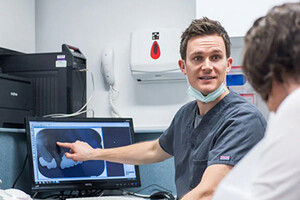
For patients, this means clearer explanations and fewer surprises. The team can show images on screen, explain what they see and walk through the plan step by step. Minimally invasive techniques are used wherever possible, so healthy tooth structure is protected and recovery is more comfortable.
Technology never replaces judgment, though. The clinicians use these tools to support their experience, not to replace it. Every plan is still shaped by careful examination, honest conversation and a clear understanding of what the patient wants.
Patients who live far away can start the conversation remotely. Initial questions, photos and existing records can be shared before the first visit, which helps the team prepare and makes the most of the time spent in the practice. Where treatment spans several stages, visits can be grouped to reduce travel for those coming from other regions or from overseas.
• Advanced digital imaging for accurate diagnosis
• Comfortable intraoral scanning instead of traditional impressions
• Digital planning and 3D printed guides
• Minimally invasive methods to protect healthy tissue
• Clear on-screen explanations for every patient
A Place Where Dentists Learn Too
Education has always been part of the practice's identity. The team regularly lectures, teaches and runs training for other dental professionals. The centre has seminar space and a long history of sharing knowledge with the wider dental community. This teaching role keeps the clinicians sharp, because explaining methods to others demands a deep understanding of the latest evidence.
It also builds trust. Around fifteen hundred referring dentists send patients to the practice, which says a great deal about the respect it has earned among peers. When other professionals choose a centre for their own patients' most complex needs, it is a strong sign of quality.
The practice is part of a wider network of dental practices, which gives it access to shared resources, training and clinical governance systems. At the same time, it keeps its own identity and culture, built on years of careful, patient-focused work. All clinicians are registered with the General Dental Council and follow strict standards for safety, hygiene and professional conduct.
The centre's values are easy to see in daily practice. Clinicians take time to listen before they recommend anything. They explain the benefits, limits and costs of each option in plain language, and they respect the patient's right to choose. Long-term health always comes before quick fixes, and prevention is treated as seriously as any complex piece of work. Regular reviews with the hygiene team help protect results for many years.
For patients in the United Kingdom and those travelling from abroad, the Scottish Centre for Excellence in Dentistry offers specialist knowledge, advanced technology, a caring approach to anxiety and a team that works together from the first visit to long-term aftercare. It is a place built for people who want their dental care done properly, explained honestly and delivered with skill.